
Ohio State University: Stop Unconstitutionally Censoring and Discriminating Against Palestinian Students
/
February 18th, 2026 — Last week, Palestine Legal wrote to Ohio State University (OSU) expressing serious concerns about the school's repeated censorship and criminalization of student speech. The legal letter demands that the school end its discriminatory enforcement of vague and overly restrictive policies to conform with the First Amendment and Title VI of the Civil Rights Act.
The letter highlights two incidents, one a Palestine study-in in October 2025 and the other a protest against U.S. immigration authorities recruiting on campus in January 2026, where the university employed its police force to silence students simply because the students engaged in speech the school disagreed with. Taken together, these two incidents show how universities' repression of pro-Palestine speech paves the way for their repression of speech opposing other human rights abuses.
OSU’s Discriminatory Enforcement of Repressive Policies Violates the First Amendment
On January 20, two weeks after a federal agent shot and killed Renee Nicole Good, around 75 students and community members protested the presence of the U.S. Customs and Border Protection at a career fair at OSU.
Despite their efforts to craft a protest that would abide by the university’s policies, protesters were threatened by university police and told to leave the venue, which was open to the campus community. Police arrested three people on charges of criminal trespass, including an individual who was simply holding a sign and others who were present but not chanting. Charges against these protesters were later dropped.
OSU’s Censorship of the Keffiyeh and Threat of Police Intervention Is Anti-Palestinian Racism, in Violation of Title VI and the First Amendment
The university's criminalization of CBP protesters came only two months after threatening the same against Palestinian students and their allies. On October 7, 2025, Palestinian students and allies held a study-in at a library on campus. Some students wore keffiyehs, which have been recognized by courts around the country as a form of Palestinian cultural expression and a symbol of support for the Palestinian cause.
In the library, a fourth-year Palestinian student removed her keffiyeh from around her neck and hung it on the back of her chair as she studied with the group. University administrators then asked the Palestinian student to remove her keffiyeh from the back of her chair. Administrators made clear their discriminatory enforcement of university policy by stating that only keffiyehs, not jackets or other clothing, would need to be removed. University administrators then threatened the Palestinian student with police involvement if she did not remove her keffiyeh.
OSU's Behavior Makes Clear: The Palestine Exception to Free Speech Will Not Stop at Palestinians
The legal letter notes that OSU's criminalization of students' immigration protest and censorship of the keffiyeh are not isolated incidents, but an escalation where policies and practices that are established to silence pro-Palestinian speech are applied more generally to silence other student activism on campus. Palestine Legal previously sent a letter to OSU on behalf of Ohio State University Divest, warning that the school had unlawfully stifled the student ballot initiative to divest from companies complicit in Israel's genocide of Palestinians. This January, in a case brought by the American Civil Liberties Union of Ohio, a federal court found that OSU had likely violated the constitutional rights of a student it had expelled for statements in support of Palestinians.
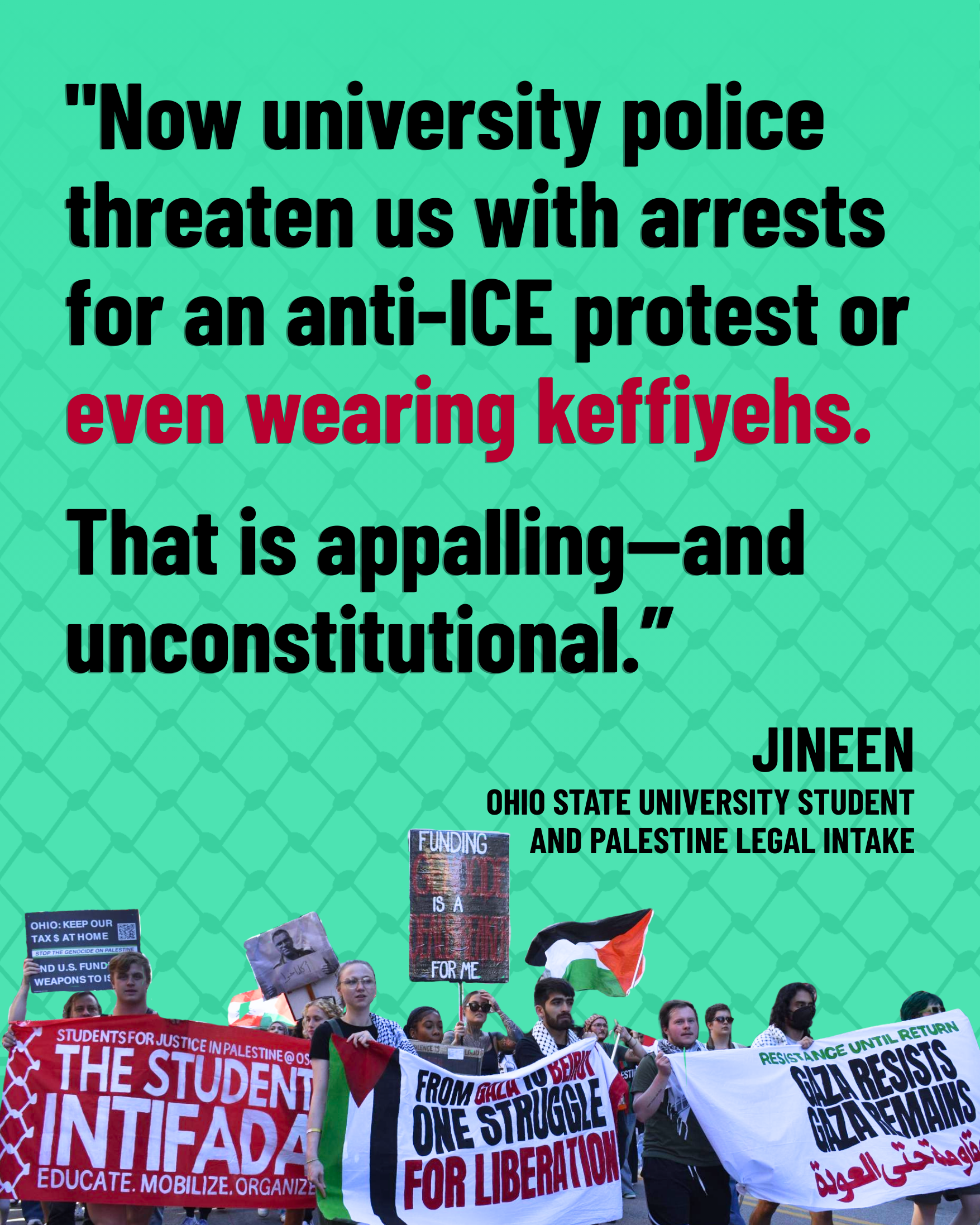
"My university has consistently sought to suppress the powerful student movement for Palestine we built on campus. Now, university police threaten us with arrests for an anti-ICE protest or even simply wearing keffiyehs," said Jineen, an OSU student and Palestine Legal intake. "That is appalling — and unconstitutional. We will not stop fighting for divestment from our university's blood-soaked investments that profit from the murder of Palestinians."
Read our letter here.