
Burst of Legal Wins Reaffirms Power of the Palestine Movement
/
Amidst Israel’s ongoing genocide in Gaza, the intensification of the US-Israeli war against Iran and Lebanon, and escalating domestic repression of attempts to protest the above, several recent legal victories are offering hope for the Palestine movement in the US.
In the last few weeks, many US courts have been rightfully ruling in favor of pro-Palestinian protesters, often affirming that they are exercising their First Amendment-protected rights to speak out and take action against Israel’s genocide. In these cases, courts have been ruling against Israel lobby groups, ICE and the Department of Homeland Security, and universities under pressure by the Trump administration to punish student protesters and suppress dissent.
These legal victories are crucial not just for the individual protesters — who now are free from ICE detention, or can return to campus after their expulsions or suspensions were dismissed — but also for the Palestine movement at large. In many instances, courts’ decisions are creating legal precedents that could help prevent future attempts at legal repression, like Israel lobby groups’ misuse of civil rights lawsuits to silence criticism of Israel and Zionism.
Though many legal fights are ongoing, we hope that these wins bolster our movement’s morale as students, workers, and everyday people of conscience continue to protest Israel’s genocide and pressure complicit institutions to divest from it.
Below, read Palestine Legal’s roundup of recent US legal wins — and news articles featuring analysis of these wins from Palestine Legal attorneys.
Leqaa Kordia is finally free after nearly a year in brutal ICE detention.
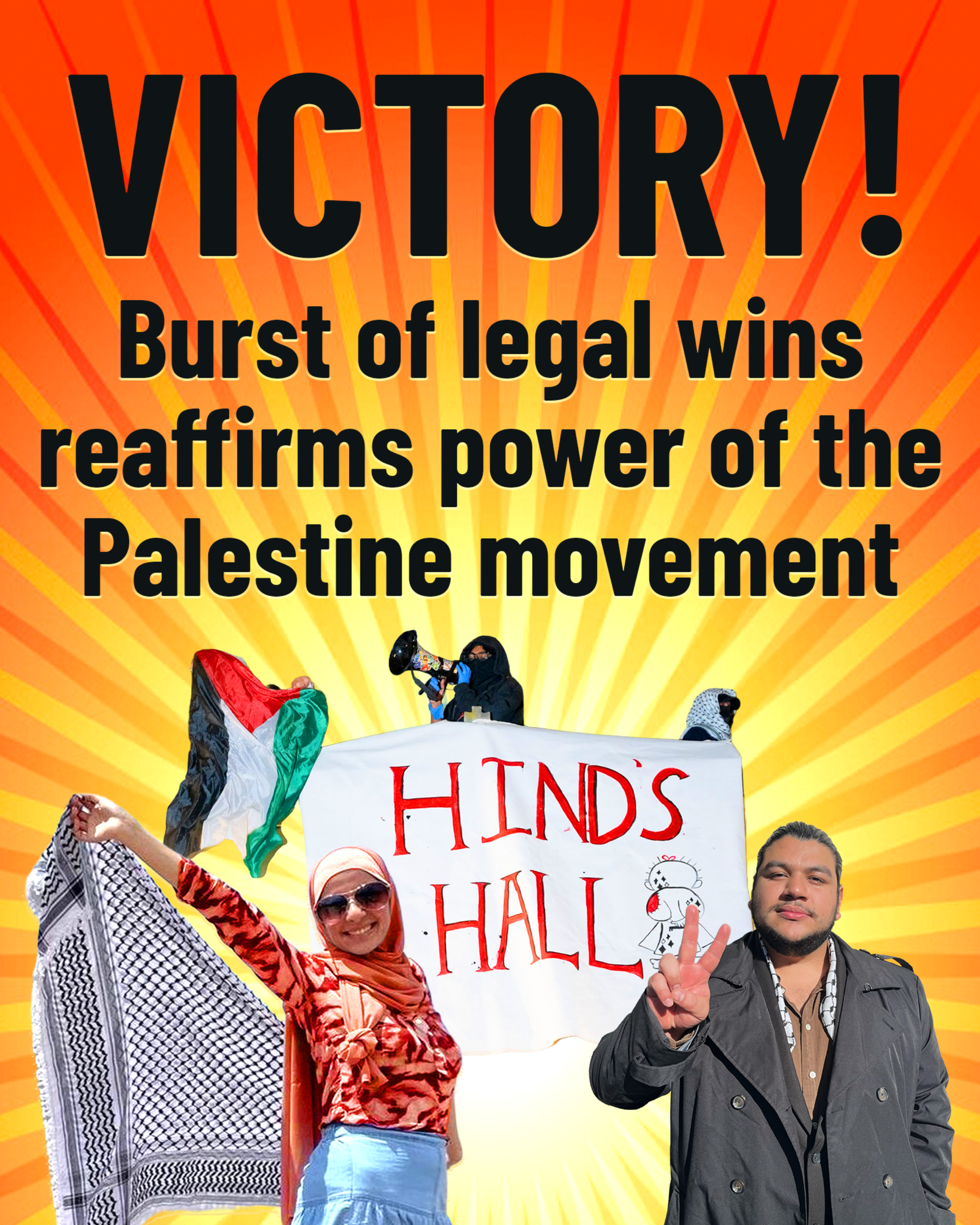
A Palestinian woman on a valid visa, Leqaa was targeted for joining protests at Columbia University in 2024.A court dismissed Columbia’s punishments of students who occupied “Hind’s Hall” in 2024.
Another court greenlit Mahmoud Khalil’s lawsuit against Columbia and the Trump admin for conspiring to violate students’ rights.Several courts have ruled that phrases like “from the river to the sea” and globalize the intifada” are constitutionally protected.
These decisions are creating legal precedents that could help stop Israel lobby groups from misusing civil rights lawsuits to silence criticism of Israel and Zionism.In the trial of Standford students facing felony charges for occupying a building, the jury couldn’t reach a verdict, declaring a mistrial.
These students were facing the most severe criminal case brought against any students protesting the genocide in Gaza.A court ruled that UMass Amherst had to reinstate a student suspended for protesting a weapons manufacturer at a career fair.
The student sued UMass for violating his free speech rights.A judge greenlit a lawsuit against an Israel lobby group that targeted Columbia and Barnard students with “doxing trucks.”
The group plastered pro-Palestinian students’ names and photos on trucks and spent several weeks driving these vehicles around Columbia’s campus.
In an article in The Guardian titled “Efforts to shut down pro-Palestinian speech face series of setbacks in court,” reporter Tom Perkins interviewed Palestine Legal’s Litigation Director, Radhika Sainath:
“The courts have said, ‘We agree, this is first amendment protected speech,’” said Radhika Sainath, an attorney with Palestine Legal, which filed briefs in many of the cases. That, she continued, has resulted in “wins for Palestinian rights because they are starting to create a body of law.”
In an article in The Hill titled “String of legal wins offers hope to college protesters,” reporter Lexi Lonas interviewed Palestine Legal’s Senior Managing Attorney, Zoha Khalili:
“A lot of schools have been, because they’re under pressure from the Trump administration, pursuing student conduct processes without necessarily having the right procedures or justifications for doing so,” said Zoha Khalili, senior managing attorney at Palestine Legal, adding “that initial part of the process” takes place completely “within the university administration.”
“They don’t have to have any kind of like neutral decisionmaker outside of the university play any kind of role. And so, universities, really under pressure from the Trump administration, have been going rogue and trying to secure harsh punishments against their own students in order to be able to testify in Congress about the fact that they punish people over these encampments or make deals with the Trump administration,” Khalili added.